
Summer Study: Ballet History, pt. 2


Even though our summer intensive is over, school is still in session here on the blog! In our last post, we followed the development of classical ballet productions from La Sylphide to Coppélia. (Purely coincidentally, these are two of the ballets that BTM has programmed for our 2026/2027 season.)
Today, we take a look from the start of the Classical Period, through 20th-century and neoclassical ballet, all the way into today's contemporary ballet. It's not an exhaustive list, but you'll recognize familiar works such as The Nutcracker, Romeo and Juliet, and more!
Classical Ballet
The previous Romantic era was the result of ballet shifting from the courts of the French kings into a less pretentious, more populist milieu. When ballet journeyed to Tsarist Russia in the 18th century, it lifted the art form back to imperial heights. This is the Classical Period of ballet.

Although Marius Petipa's name came up many times in the first half of this topic, the Classical Period is the heart and soul of his contributions to ballet. It's also when composer Pyotr Ilyich Tchaikovsky appears on the scene. Tchaikovsky supplied the music for an early version of Swan Lake in 1877, but that production lacked the spark of Petipa and Ivanov's later iconic choreography. Fortunately for us, Tchaikovsky didn't let that scare him away from composing for dance.
The Sleeping Beauty: 1890
At the behest of Imperial Theatres director Ivan Vsevolozhsky, Tchaikovsky first collaborated with Marius Petipa on The Sleeping Beauty in 1890. The result is an excellent example of the Classical period of ballet.
Gone are the short, sometimes single-act ballets of the Romantic period. Russian audiences expected ballets lasting an entire evening, and Sleeping Beauty delivered so well on this that during the choreographic process Petipa had to ask that some of the music be shortened.

The characters also demonstrate a change from the Romantic period. Gone are the simple peasant girls, Neapolitan fishermen, and sleepy Scotsmen. In Sleeping Beauty's prologue, the human characters such as the king and queen are pushed to the fringes of the stage to showcase the otherworldly crew of fairies who oppose the wicked fairy Carabosse.

Even when we do have a human protagonist, it is the beautiful and graceful Princess Aurora. Where you might describe many previous ballet heroines as approachable "girl next door" types, Prince Aurora's nobility makes her something else entirely. Petipa's original production set the ballet in Louis XIV's French court, bringing ballet's history surprisingly full circle.
There's a lot to say about Sleeping Beauty, and in fact it was the first ever ballet featured on our blog! You can read more about it in our post from 2024.
The Nutcracker: 1892
Just two years later, Tchaikovsky and Petipa worked together again on what would become one of the most famous ballets in the world: The Nutcracker.
The inspiration for The Nutcracker came from an E.T.A. Hoffman story, The Nutcracker and the Mouse King, which had been translated into French by Alexandre Dumas. Tchaikovsky entered the composition process somewhat reluctantly, as he was not the biggest fan of Dumas's family-friendly edits to Hoffman's dark tale. Making the process even more difficult for him, Tchaikovsky's beloved sister Alexandra passed away while he was working on the score. Some attribute dramatic and melancholy music for the grand pas de deux to this great loss in Tchaikovsky's personal life.

Although The Nutcracker is almost synonymous with ballet in American pop culture, the original 1892 production was a flop. The structure of the show was unusual, with children being featured so prominently and the lead ballerina not appearing until the second act. Later productions would try to allay these concerns, starting with Alexander Gorsky in 1919.

Gorsky gave the role of Clara and the Nutcracker Prince to adults, whom the audience would follow from the beginning of the ballet through to the grand pas. As companies around the world have adapted The Nutcracker for their own dancers, countless choreographers have put their own spin on the production.
To read more about The Nutcracker and how it adapted E.T.A. Hoffman's story, check out our blog post "A Brief History of the Nutcracker" with photos drawn from our previous production.
Swan Lake: 1895
Tchaikovsky had composed music for a production of Swan Lake choreographed by Julius Reisinger in 1877, but it had failed to capture the public's imagination. (You can learn more about that history in a previous Swan Lake blog post)

The original Swan Lake continued to be edited and revived for the next several years, but it eventually left the repertory of the Imperial Theatres until Ivan Vsevolozhsky proposed reviving it.
Tchaikovsky passed away before he could see Marius Petipa's take on his first ballet, but the composer Riccardo Drigo helped adapt Swan Lake's score into something closer to what we know today.

Marius Petipa's own health was failing at this time, so he split the choreography with ballet master Lev Ivanov: Petipa took on the rousing and imperial dancing of Acts I and III, while Ivanov choreographed the famous ballet blanc swan scenes in Acts II and IV. The result is ballet history.
Although the narratives of classical ballet became increasingly fairytale-focused during this period, ballet as an institution is still subject to the real-world circumstances it resides in. Just as the French Revolution had helped knock ballet out of the realm of the French kings, the changing world going into the 20th century would also impact ballet's evolution.
20th-Century and Neoclassical Ballet
Globalization, nationalism, and counterculturalism all challenged ballet's status qu throughout the 20th century. With contemporary composers breaking the rules of classical composition and early modern dancers such as Isadora Duncan rejecting ballet's strict form and structure, ballet choreographers had many influences outside of the art form. Perhaps most impactfully, the Ballets Russes, an internationally touring company led by Sergei Diaghilev, brought experimental, intrinsically Russian ballet to the world.
Les Sylphides: 1909
Les Sylphides' choreographer, Mikhail Fokine, had been a pupil of the Imperial Theater School during the time of Marius Petipa but also absorbed many influences from the wider dance world. His Les Sylphides, which premiered with Anna Pavlova, Vaslav Nijinsky, Tamara Karsavina, and Alexandra Baldina in the leading roles, harkens back to the 19th-century work La Sylphide.*

Just like fashion sense, tastes in ballet are often cyclical. Les Sylphides feels like it should be a much older work because it was specifically evoking the softness and romanticism of that time period. For Les Sylphides, Fokine rejected the showmanship and virtuosity of the Classical period in favor of centering the feeling one gets from the music and stylized movement.

The Firebird: 1910
Mikhail Fokine crafted The Firebird for the Ballets Russes the very next year. If Fokine's Les Sylphides echoed back to French and Danish Romanticism, his Firebird was an effort to create a ballet that was unapologetically Russian.

Although Russia had been the major hub for the Classical Period, it was dominated by French and Italian ballet masters and performers like Marius Petipa and Enrico Cecchetti. Mikhail Fokine and his contemporary, Agrippina Vaganova, were part of a new generation of Russian artists who would carry on ballet's legacy.
The Firebird was inspired by Russian folktales, and the Ballets Russes enlisted the up-and-coming Russian composer Igor Stravinsky to create the score. Although it didn't incorporate the same level of primitivism that would lead audiences to riot at The Rite of Spring three years later, the dissonance of Stravinsky's score and the diverse movement of the different characters (delicate princesses, grotesque monsters, and the avian Firebird herself) created something distinctly modern.

There's a poignancy to this national pride: The Firebird was a ballet that celebrated Russian culture, but it was created by a company that never performed in Russia.
Looking ahead, world events such as the outbreak of WWI and the Russian Revolution would challenge ballet to further adapt and evolve. Soviet-era ballet would transform itself into an accessible art form for the proletariat with themes tailored for the current regime.
Some Russian dancers chose exile, including the young choreographer George Balanchine. His Apollon Musagète, which premiered with the Ballets Russes in 1928, is one of the earliest examples of Neoclassical Ballet. In the 1930s, his work in New York City would lay the foundation for his contributions to American ballet.
Romeo and Juliet: 1938/1940
One contribution of the Soviet Union to ballet was adapting Romeo and Juliet for dance. Composer Sergei Prokofiev originally wanted to approach the project by providing the story with a happy ending, but fortunately he was talked out of it!
Romeo and Juliet originally premiered in 1938 with choreography by Ivo Váňa-Psota, but the 1940 production with choreography by Leonid Lavrosky became the more influential version. This Romeo and Juliet premiered at the Kirov Theatre, which had been the Imperial Theatre before the revolution. Today you might know it as the Mariinsky.

Shakespeare's rich source material and Prokofiev's distinctive score have made this ballet a tempting project, so there have been many original productions since then: to name just a few, Frederick Ashton in 1955, John Cranko in 1962, Sir Kenneth MacMillan in 1965 (one of the best-known versions), John Neumeier in 1971, Rudolf Nureyev in 1977, Yuri Grigorovich in 1979, and Alexei Ratmansky in 2011.
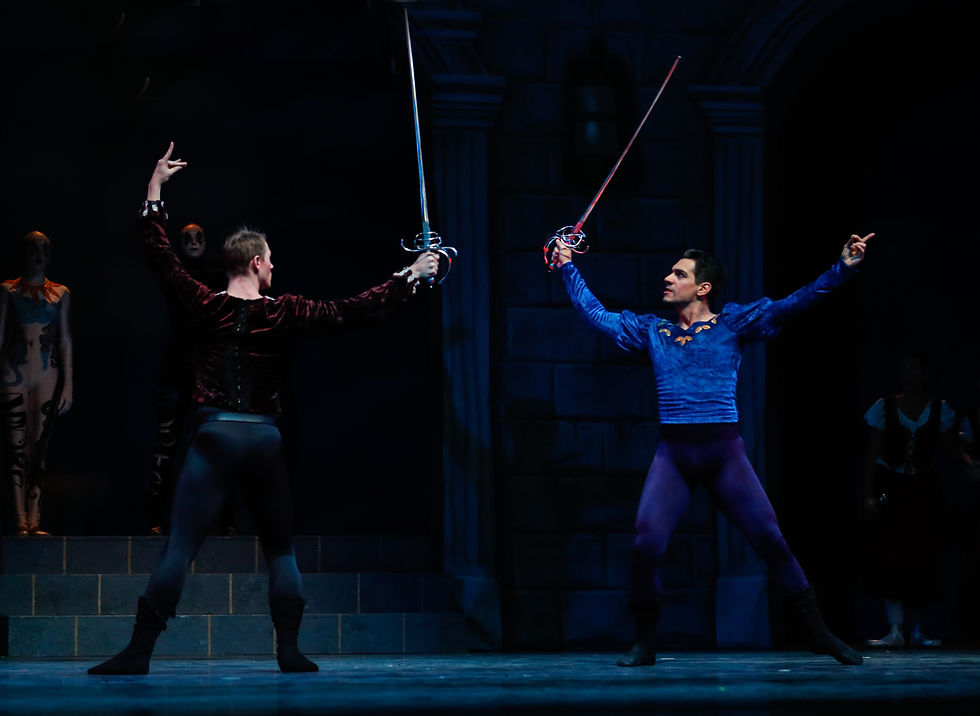
When BTM most recently performed Romeo and Juliet, it was with original choreography by former Artistic Director Dianna Cuatto.
Other Neoclassical Works
Neoclassical ballet continued to develop throughout the 20th century. Where neo-romantic works like Les Sylphides yearned for the softness of the Romantic Period, neoclassical ballets heighten the advanced technique of the Classical Period by stripping away the nonessentials. There are neoclassical ballets that tell a story, but the period is characterized by plotless and characterless ballets that feature pure dance without fussy sets or costumes. To audience members, the movements may seem bigger, sharper, and overextended compared to classical ballet.

During the Neoclassical Period, choreographers made their mark not just in one geographic region but all around the world. In the United States, George Balanchine and Jerome Robbins were known for their work at New York City Ballet. In Britain, Frederick Ashton and Kenneth MacMillan created many narrative and non-narrative works for the Royal Ballet.
John Cranko, who originally worked in London, went on to direct and choreograph for Stuttgart Ballet. Serge Lifar and later Roland Petit were both instrumental in their work at the Paris Opera Ballet.
Contemporary Ballet
All throughout the 20th century, modern dance developed in parallel to ballet. Although there was some overlap, it wasn't surprising for modern dance and classical ballet to be considered somewhat separate endeavors.
Over time, those barriers have lifted. New ballet works often include a blend of classical ballet, neoclassical movement, modern dance, and postmodernism--along with any other movement style the choreographer desires.
This has drastically changed the training of the modern-day dancer, as students must be versatile in multiple styles to attain their dream of becoming a professional dancer.

It's difficult to name only a few choreographers who have impacted dance in the late 20th and early 21st centuries, but some of the most consequential include Twyla Tharp, William Forsythe, and Jiří Kylián. More recently, audiences have enjoyed the works of choreographers such as Wayne McGregor, Crystal Pite, Christopher Wheeldon, Darrell Grand Moultrie, Annabelle Lopez Ochoa, and many, many more.

In contemporary ballet, choreographers are free to use whatever dance vocabulary will best help them convey the theme, emotion, or story they want to project. At BTM, you're most likely to see contemporary movement in our yearly production of Momentum, which features a range of different pieces performed in bare feet, soft shoes, or fully en pointe.

Although present-day dance may incorporate many styles and influences, the beauty of ballet is that it has persisted. Over the course of a single performance season, audiences may see Romantic, Classical, Neoclassical, and Contemporary works all performed by the same company of artists. Even as the technique and choreography change, ballet's important traditions create a strong foundation for its future.

This season, BTM is looking forward to programming works that celebrate many corners of ballet history! I hope that these last two posts have helped show how these different ballets fit together, and what each one has meant for the development of this art form.
Season subscriptions are still available, but single tickets go on sale on August 10, 2026! Keep your eye on our 2026/2027 season page to reserve your seats for La Sylphide, The Nutcracker, Momentum, and Coppélia.

Promotional photos by Joanne Salyer
*Keeping these two ballets straight is sometimes tricky. I always remember it as one sylph ("la") versus many ("les"). La Sylphide, the 1832 narrative ballet originally by Filippo Taglioni, takes place in Scotland and centers around a single lead sylph. Les Sylphides, Fokine's 1909 neo-romantic work, is concerned with a few leading sylphs, who each have their own solo variation.


