
Summer Study: A Ballet History Elective

Updated: Jul 28

Since we last connected here on the blog, it's been a busy time at our summer intensive! Our Beginner/Intermediate students successfully performed for friends and family at the end of their two-week program, and last week the Intermediate level started three weeks of dancing from 9 am to 4 pm. In parallel, our advanced level is entering week four of their five-week intensive.

The intermediate students are mostly in late-elementary school through middle school, and they have a full schedule. In addition to classes in ballet, contemporary, jazz, conditioning, and pointe or pre-pointe, the intermediate level also has what's always my favorite class to teach: a weekly lecture on ballet vocabulary, theory, and history.
These dancers are at an age that is naturally inquisitive, which makes the lecture class a lot of fun. There is a systematic logic hiding in ballet terminology and technique, and I love diving into it with them. Why is one of our basic body positions called à la quatrième devant, and what does that tell us about what to do? Why do we call that beautiful stretched position arabesque? Why do the names for the steps pas de chat, saut de chat, and saut de basque overlap?*

We answer these questions and many more, but one of my favorite parts to teach is a brief survey of ballet history. As part of our summer study here on the blog, I've gathered some of the classics of BTM's repertory for a quick history lesson.
Today we'll follow the rise of ballet from the Romantic Period up until the Classical Period. This is by no means an exhaustive list, but I hope it puts into perspective how ballet has grown over the years and how that history is represented by what you see onstage.
Precursors to Ballet
The courtly dance that would become ballet, then known as "balleto", made its way to the French courts when the Florentine noble Catherine de Medici married Henri II. In those days, courtiers wore low-heeled shoes and sumptuously heavy garments, which created a more restrained aesthetic than anything we know today.

The elegance and courtliness of classical ballet are a direct result of it developing in the courts of the French kings. Louis XIV, known as the Sun King because of his famous dance performance as Apollo, cemented ballet's future by founding the Académie Royale de Danse in 1661.
As the French Revolution drastically changed French culture in the late 18th century, ballet survived by appealing to the republican ideals of the new government. Over time, dancers moved away from aristocratic high heels and restricting costumes so that their movements could become more athletic and impressive.
Romantic Ballet
La Sylphide: 1832

La Sylphide, which BTM will perform for the first time this season, is the oldest ballet production still performed. In 1832, French choreographer Filippo Taglioni created the ballet as a vehicle for his daughter, the famous Marie Taglioni, to show off her innovation: dancing en pointe as part of the character she was portraying, rather than just as a circus trick. By perching on the tips of her toes, Marie Taglioni created the illusion that she was a lighter-than-air sylph.

After seeing La Sylphide, the dancer and choreographer August Bournoville loved it so much that he wanted to bring it back for the Royal Danish Ballet to perform. Unfortunately, he thought that they were asking too much money to use the musical score. He decided to create his own version of the story and commissioned a new score from Herman Severin Løvenskiold.
In a twist of fate, Taglioni's production was lost later in the 19th century. Pierre Lacotte reconstructed Taglioni's Sylphide for the Paris Opera Ballet in 1972, using the original score by Jean-Madeleine Schneitzhoeffer, but it's Bournonville's production that is otherwise performed around the world. La Sylphide would lay the groundwork for many of the Romantic ballets that followed.
Giselle: 1841

We've spoken in detail about Giselle previously on the blog, but it can't be overstated how important it is as a Romantic ballet. Premiering in 1841, it owes a lot of inspiration to Taglioni's La Sylphide nine years earlier.
Like La Sylphide, Giselle depicts life for ordinary people who find themselves swept into a supernatural ballet blanc. This reflects a major component of the Romantic Period: earlier iterations such as the ballet de cour and ballet d'action were more concerned with kings and Greek gods because that was what appealed to French royalty and nobility. When ballet democratized, so too did its characters.

This leads to ballets about guileless peasant girls and unwitting Scotsmen with relatable wants and fears. Their encounters with the supernatural — wilis in Giselle's case and sylphs in James's — represent another important element of the Romantic period.
The production that we know today is actually based on Marius Petipa's late nineteenth-century revival (a recurring theme throughout this post), but Giselle remains the epitome of Romantic ballet.
Napoli: 1842

Although Paris, France, was a significant center of dance during the Romantic period, ballet had already begun to spread. After the Danish August Bournonville premiered his La Sylphide in 1836, he got into some trouble with the king of Denmark in 1841. (It's a long story.) He had to get out of Copenhagen, which led him to pass through the city of Naples. Bournonville fell in love.

Napoli is an example of how Romantic ballet is frequently interested in exoticism: for the French, setting La Sylphide in Scotland made it an exotic story. For Bournonville, Naples was equally as fantastic. He staged Napoli upon his return to Denmark to celebrate the local color and culture he had enjoyed.

Napoli follows a Romantic structure you're probably beginning to recognize: in the first act, an obstacle stands in the way of our two romantic leads being together. In the second, they are transported to a strange, supernatural place--here the Blue Grotto--where some kind of malevolent force is supported by a corps de ballet of dancers. In Napoli, the fisherman Gennaro must remind Teresina who she is so that she can transform from a naiad back into a human. When they return home, there is joyful dancing to celebrate.
Much like other Romantic-era choreography, Bournonville's work lacks the complex partnering and overhead lifts that characterize later ballets. Most of the time, Teresina and Gennaro are dancing side by side rather than one supporting the other. In place of complicated partnering, however, Napoli highlights intricate footwork and sincere characters that still resonate with audiences today.
You can read more about Napoli on the blog.
Transitioning from Romantic to Classical
The Romantic period gradually declined during the mid-18th century, which can make it tricky to describe some productions as strictly Classical or Romantic. Further complicating this is that some productions (like Giselle) are better known for their Classical-era revivals! The following three works from BTM's repertory all reflect this transitional period from Romantic ideals to Classical ones.
La Esmeralda: 1844 (revived 1886)
La Esmeralda originated at the Paris Opera Ballet in 1844, with choreography by Jules Perrot. The ballet in its initial form was drastically different from what BTM performed this April. Whereas the modern production has three acts with five distinct scenes, Perrot's original was only one act long!
As French ballet's influence waned during the 19th century, the significance of Russian ballet grew. In Saint Petersburg, Perrot expanded on La Esmeralda for the ballerina Fanny Elssler's performances. When French choreographer Marius Petipa revived La Esmeralda there in 1886, he drew upon Perrot's work.

Something significant missing from the original production is the Esmeralda pas de six, pictured above. Marius Petipa is responsible for standardizing many of the elements we associate with classical ballet today, including the grand pas de deux (grand dance for two).
A grand pas follows the pattern of an entrance for the couple, a pas de deux section focusing on partnering, variations (solo dancing) for the man and woman, and a flashy coda that highlights impressive leaps and turns.
In the Esmeralda pas de six, Petipa plays with this structure by adding Esmeralda's four friends. They serve as a small corps de ballet in some of the staging, and dance in between the pas de deux and Esmeralda's variation.

Unlike most of the ballets on this list, La Esmeralda is infrequently performed in the United States. To learn more, visit our La Esmeralda blog post.
Don Quixote: 1869 (Revived 1900)
We've talked about some of the ballets that Marius Petipa revived, but Don Quixote is the first ballet on this list that he originated. The novel by Miguel de Cervantes had first been adapted for dance in 1740, but Petipa's is the version that stuck.

Once again, there's a Romantic element of exoticism: the French choreographer was presenting a Russian audience with Spanish culture and dance. It still follows the familiar Romantic roadmap of a boy and girl whose attempts to be together lead them from the conventional world to an otherworldly place. In Don Quixote, that means into the title character's dream of an imaginary girl named Dulcinea.

Don Quixote features an early appearance of mistaken identity, which is a recurring theme in story ballets. Don Quixote becomes fascinated by Kitri because he thinks that she's his Dulcinea. Although Kitri and the girl of Don Quixote's dreams were originally played by two different ballerinas, Petipa's 1871 production and most modern productions have them played by the same dancer.
Much like Petipa created the better-known revivals of earlier ballets, Alexander Gorsky's 1902 version of Don Quixote is more closely related to the production performed today. The iconic fouetté turns that Kitri performs during the Act III grand pas de deux were likely added sometime in the 1890s or early 1900s.
Coppélia: 1870 (Revived 1884)

Coppélia returns to BTM as part of our 2026/2027 season! This comedic love story, first choreographed by Arthur Saint-Léon in 1870, is considered the final ballet of the Romantic period.
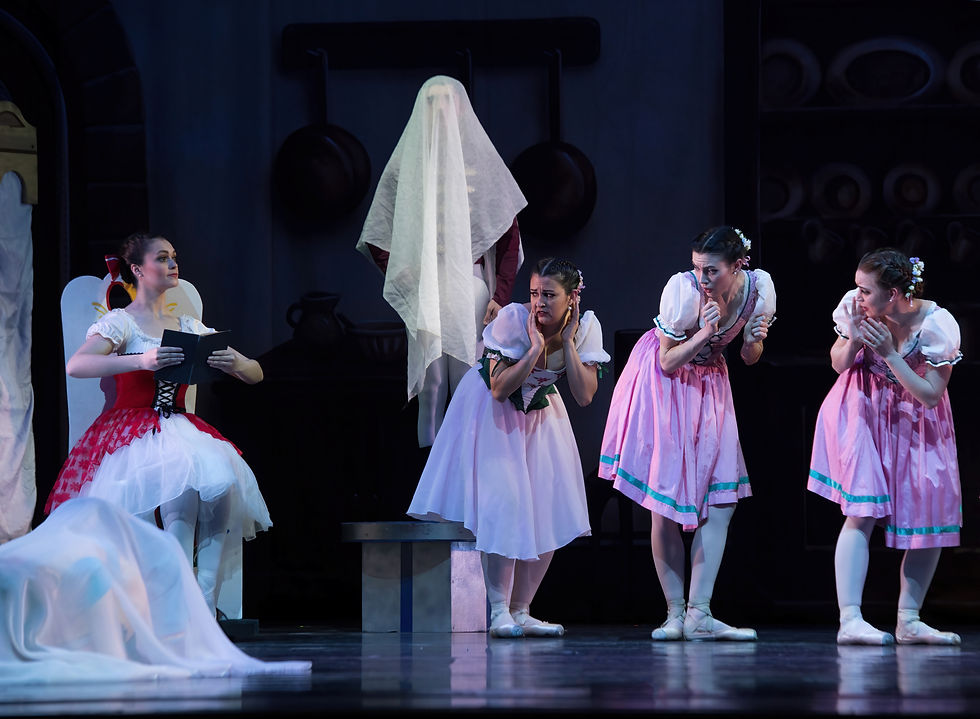
Some familiar ingredients make a new recipe in this story ballet. When the peasant girl Swanhilda suspects that her boyfriend has fallen in love with a mysterious girl, she takes matters into her own hands. But instead of entering the misty forest clearing of wilis in Giselle or Don Quixote's wondrous dream of dryads, the strange place Swanhilda and her friends go in Coppélia is the more conventionally fantastic toyshop of Dr. Coppélius's workshop.
Although Saint-Léon originated the ballet, the Coppélia typically performed is handed down from — you guessed it — Marius Petipa. He revived the French ballet in 1884 with an interesting change: he gave the role of Franz to a male dancer.

At the end of the Romantic era, the men of the Paris Opera largely only performed pantomime roles. Where a male character was called upon to dance, he was played by a woman en travesti. This was not the case in Russia, so Petipa reshaped the ballet for a male dancer and added a pas de deux.
Coppélia as it's performed today has the Romantic elements of an idyllic village setting with joyful peasant dances and relatable lead characters with human struggles, while also containing the more sophisticated partnering and storytelling we associate with the Classical period. BTM is looking forward to performing it next season!
The Classical Period, 20th Century, and beyond — coming soon!
You may be surprised that a few heavy hitters haven't shown up yet. Where's Tchaikovsky? Specifically, where's Sleeping Beauty, Swan Lake, and The Nutcracker? All three ballets are products of the 1890s, so they emerged quite late in ballet's development!
We'll continue this survey of ballet's history another time, as I'm excited to share more of the ballets BTM has performed and how they fit into the timeline of ballet history. Also keep your eyes out for more updates on how our students have been training this summer, both at BTM and across the country!

*For the curious: A la quatrième means "to the fourth" in French, and devant means "in front." When you stand à la quatrième devant, you face the mirror with your feet in a ballet fourth position, but with your front foot pointed.
Arabesque draws its name from the intricate, interlacing design motif of Islamic architecture. Just as an architectural arabesque creates a visually harmonious line, so too does a balletic arabesque.
Pas de chat is translated in ballet as "step of the cat," saut de chat as "jump of the cat," and saut de basque as "jump of the Basque," because of the influence of the Basque region of Spain. Pas de chat and saut de chat both initiate with the leading foot lifting to the knee, though saut de chat extends into a full split in the air. Saut de basque, which turns in the air with one foot at the knee, has a similar name to saut de chat because they are both large (grand) jumping steps.


